How Many Bags of Soil for Raised Bed?
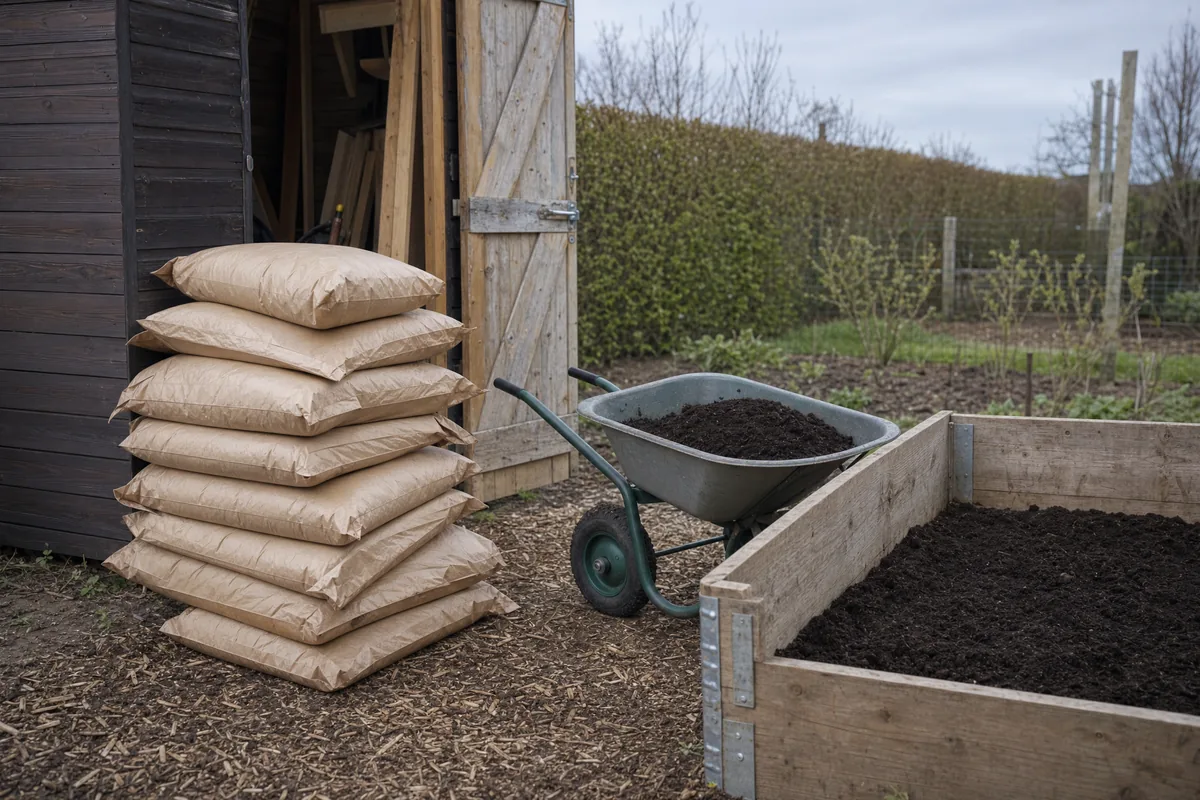
Read the volume on your bag label, then calculate the number of whole bags for your bed.
Count your soil bags
Enter your bed dimensions and calculate to see all results.
Using inside dimensions from your lumber plan.
Soil volume
ft³
How we calculated
V = area × (bed depth − filler depth) / 12 × (1 + settling % / 100) × beds. Dimensions are inches; area is ft².
Bulk volume
yd³
How we calculated
Cubic yards = cubic feet / 27.
Soil in liters
L
How we calculated
Liters = cubic feet × 28.316846592.
Soil in cubic meters
m³
Whole bags to buy
How we calculated
Bags = ceil(V / bagFt³ − 1e-9). Mix components are rounded separately.
Bagged or bulk?
Example price, not market data. Enter your local quotes.
Bagged soil
- Total bags
- 24
- Total cost
- $120.00
Bulk soil
- Order volume
- 1.50 yd³
- Total including delivery
- $60.00
Bulk soil costs $60.00 less.
Break-even bag price: $2.50 per bag.
How we calculated
Bag cost = rounded-up bag count × price per bag.
Bulk cost = rounded-up order volume × price per yd³ + delivery.
Break-even bag price = bulk cost ÷ bag count.
Bag counts and bulk increments are rounded up by the calculator before prices are applied. Prices come from your inputs.
Where to buy
For bulk soil, search for a local soil yard or landscape supplier and ask about minimum orders and delivery charges. Compare their quote using the calculator.
- Bagged raised bed soil(paid link)
The short answer for a 4 × 8 bed
A 4 × 8 ft raised bed filled 12 in deep holds 32 ft³ of soil. With 1.5 cu ft bags that is 22 bags; with 2 cu ft bags it is 16. If you add a 10% settling allowance, the volume becomes 35.2 ft³ and the counts rise to 24 and 18 bags. For any other bed, use the calculator above: it runs the same arithmetic for your exact measurements.
Four steps from bed size to bag count
- Find the soil volume. Multiply the inside length and width in feet, then multiply by the fill depth in inches divided by 12. That gives cubic feet.
- Decide on an allowance. Soil settles after watering. We default to 10%, but that figure is an assumption rather than a measured rate, so you can set anything from 0% to 25%.
- Convert the bag label to cubic feet. A 1.5 cu ft bag needs no conversion. Quarts and liters do, and the calculator handles them.
- Divide and round up. You cannot buy part of a bag, so the result always rounds up to the next whole bag.
Whole bags by bed size, with a 10% allowance
This table adds the 10% settling assumption. The reference table further down shows the same idea without any allowance, so you can compare the two. All sizes are inside dimensions.
| Inside bed (ft) × depth (in) | Soil ft³ | 1 cu ft bags | 1.5 cu ft bags | 2 cu ft bags | 3 cu ft bags |
|---|---|---|---|---|---|
| 2 × 4 × 12 | 8.80 | 9 | 6 | 5 | 3 |
| 4 × 4 × 12 | 17.60 | 18 | 12 | 9 | 6 |
| 3 × 6 × 10 | 16.50 | 17 | 11 | 9 | 6 |
| 2 × 8 × 10 | 14.67 | 15 | 10 | 8 | 5 |
| 4 × 6 × 12 | 26.40 | 27 | 18 | 14 | 9 |
| 4 × 8 × 6 | 17.60 | 18 | 12 | 9 | 6 |
| 4 × 8 × 12 | 35.20 | 36 | 24 | 18 | 12 |
| 4 × 12 × 12 | 52.80 | 53 | 36 | 27 | 18 |
Two rows show why depth matters as much as footprint: a 4 × 8 ft bed filled 6 in deep and a 4 × 4 ft bed filled 12 in deep need exactly the same number of bags.
Bags labeled in quarts or liters
Potting mixes and smaller bags are often labeled in quarts, and bags sold outside the US are often labeled in liters. The quarts on soil bags are US dry quarts, which are larger than liquid quarts: one dry quart is 67.200625 in³, so a cubic foot holds 25.71405 dry quarts. An 8 qt bag therefore holds only 0.311 ft³, about a fifth of a 1.5 cu ft bag. Liters convert at 28.316846592 L per cubic foot.
Here is the same 4 × 8 ft bed, 12 in deep, with the 10% allowance (35.2 ft³), in label sizes that use those units:
| Bag label | Bag volume (ft³) | Whole bags |
|---|---|---|
| 8 dry qt | 0.311 | 114 |
| 16 dry qt | 0.622 | 57 |
| 32 dry qt | 1.244 | 29 |
| 40 L | 1.413 | 25 |
| 50 L | 1.766 | 20 |
Small bags add up quickly. For a full-size bed they mostly make sense for a top layer or for a mix component that you only need a little of.
Why the count always rounds up, but never by accident
Rounding up is the only safe choice for whole bags, but computers can make it misbehave. A 3 × 6 ft bed filled 10 in deep is exactly 15 ft³. Divided by a 1 cu ft bag, that should be exactly 15 bags. In floating-point arithmetic the division can come out a hair above the whole number, and a naive "round up" would add a sixteenth bag you do not need. The calculator subtracts a tiny tolerance (one billionth) before rounding so exact divisions stay exact.
If your bed is built from lumber
Board thickness eats into the space you fill. A bed with a 4 × 8 ft outside footprint built from two courses of 2x6 lumber is 11 in tall (2x6 boards are actually 5.5 in wide) and 93 × 45 in inside. Filled to the top, that interior holds 26.64 ft³, or 18 bags of 1.5 cu ft; with the 10% allowance it is 29.3 ft³ and 20 bags. That is fewer than the 22 bags you would estimate from the outside footprint at 12 in. The raised garden bed plans tool calculates the inside dimensions for any board size and number of courses.
Buying more than one product
If you fill the bed with a blend, for example topsoil, compost and an amendment, each product is bought in its own whole bags. Rounding happens once per product, so a blend can need more bags in total than a single product would. With a 60 / 30 / 10 split for the 35.2 ft³ bed above, the calculator asks for 15 + 8 + 3 = 26 bags of 1.5 cu ft, against 24 bags if you used a single product. These percentages are only an illustration of the rounding, not a recommended recipe.
When bag counts get large
Bag counts grow in step with volume, while bulk soil from a landscape supplier is priced per cubic yard, usually with a minimum order and a delivery charge. For one small bed, bags are often simpler. For several beds, compare both with your own quotes in the raised garden bed soil calculator, which shows the bag price at which bulk becomes the cheaper choice.
Before you buy extra bags as a safety margin, check whether your store accepts returns of unopened bags. Partly used bags are useful for topping up the bed later, as the soil settles.
How we calculated
Volume (ft³) = inside length (ft) × inside width (ft) × soil depth (in) / 12 × (1 + settling % / 100) × beds
Bag volume (ft³) = cu ft on label, or quarts / 25.71405, or liters / 28.316846592
Bags = ceil(volume / bag volume − 0.000000001)
Assumptions. The 10% settling allowance is an assumption: compaction after watering is widely mentioned, but we have no single published rate for it, so it is adjustable from 0% to 25%. Bag volumes are taken from the label as printed; we do not account for how loosely or tightly a particular bag is packed. The calculator does not estimate weight.
Common bed sizes: whole-bag reference
No filler or settling allowance in this table. Dimensions are inside measurements.
| Bed (ft) × soil depth (in) | Soil ft³ | 1.5 cu ft bags | 2 cu ft bags |
|---|---|---|---|
| 4 × 4 × 6 | 8.00 | 6 | 4 |
| 3 × 6 × 10 | 15.00 | 10 | 8 |
| 4 × 8 × 12 | 32.00 | 22 | 16 |
Frequently asked questions
How many 1.5 cubic foot bags fill a 4 by 8 foot bed?
For 12 inches of soil depth and no settling allowance, 32 cubic feet requires 22 bags. With a 10% allowance, it requires 24 bags.
Can I use dry-quart or liter bag sizes?
Yes. The calculator converts dry quarts using 25.71405 dry quarts per cubic foot and liters using 28.316846592 liters per cubic foot.
Why are bag counts rounded up?
You buy whole bags. The calculator rounds the required volume divided by bag volume up to a whole bag, allowing for floating-point precision.
How many bags of soil does a 4 by 4 raised bed need?
At 12 inches of soil depth, a 4 by 4 foot bed holds 16 cubic feet: 11 bags of 1.5 cubic feet or 8 bags of 2 cubic feet with no allowance. With a 10% allowance, it needs 12 or 9 bags.