Raised Garden Bed Plans
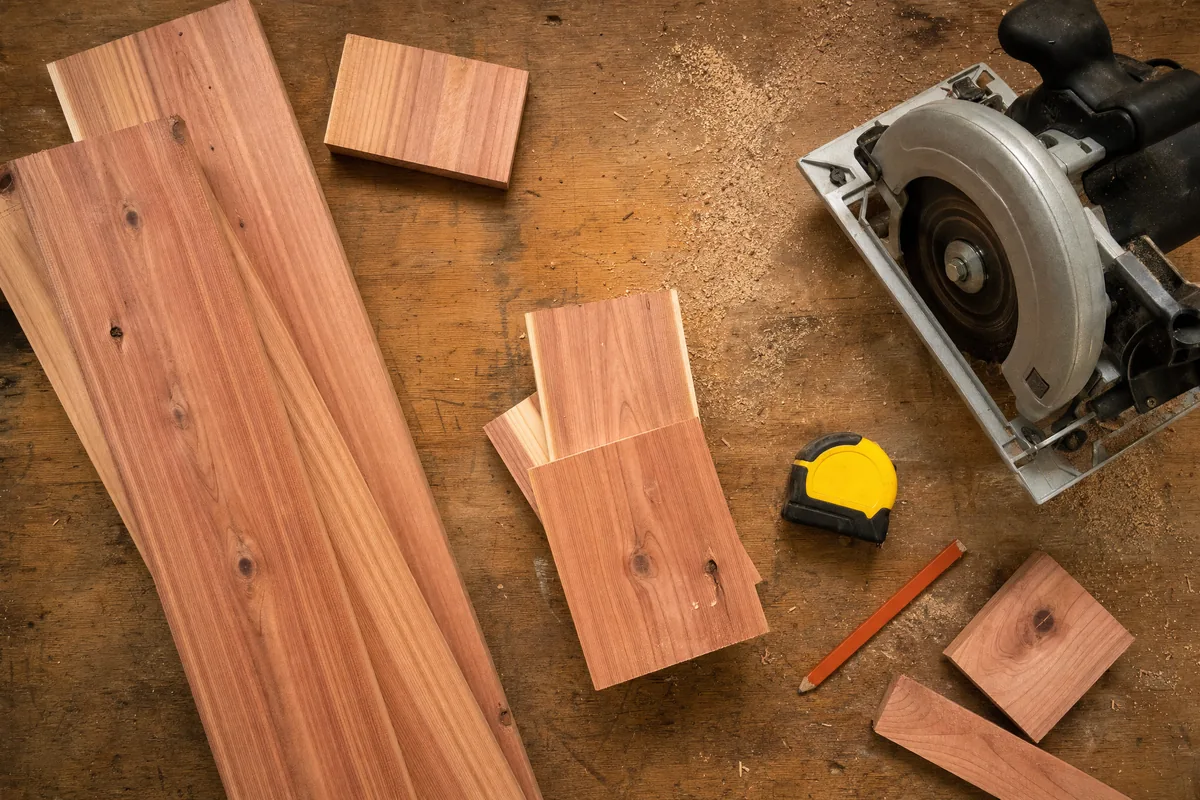
Plan a rectangular butt-joint bed using outside dimensions, actual board sizes, and your chosen stock lengths.
Create your cut list
Calculate to see your cut list and purchasing quantities.
Bed height
in
Inside dimensions
in
How we calculated
Inside length = outside length − 2 × actual thickness. Inside width = outside width − 2 × actual thickness.
Cut list
| Size | Cut length (in) | Quantity |
|---|
Purchase list
| Size | Stock (ft) | Quantity |
|---|
Board cutting diagrams
First-fit decreasing is a planning heuristic; it may not be the minimum. Numbered pieces run left to right. Remainders are shown after the calculator deducts kerf.
1: 96 in. Remainder: 0 in.
1: 96 in. Remainder: 0 in.
1: 96 in. Remainder: 0 in.
1: 96 in. Remainder: 0 in.
1: 45 in · 2: 45 in. Remainder: 5.75 in.
1: 45 in · 2: 45 in. Remainder: 5.75 in.
Use inside dimensions in the soil calculator · Preview a planting grid
Where to buy
Compare lumber prices at local lumber yards. If you prefer a kit, compare its dimensions with your calculated plan.
What these raised garden bed plans build
The generator above draws up one well-understood design: a rectangular, box-style bed with butt joints at the corners. The two long sides run the full outside length of the bed. The two short sides fit between them, so each one is the outside width minus two board thicknesses. You stack one to four courses of the same board to reach the height you want, and you can add a post inside each corner to tie the courses together.
That design is deliberately simple. It needs only straight crosscuts, so a hand saw or circular saw is enough, and every number in the plan can be checked with a tape measure. The tool turns your outside dimensions into three things: a cut list, a purchase list of whole boards, and a diagram showing which pieces come out of which board.
Common bed plans at a glance
Each row below was generated by the same function as the tool, with 8 ft as the preferred stock length, 8, 10, 12 and 16 ft boards available, and a 1/8 in saw kerf.
| Outside size, board, courses | Height (in) | Inside (in) | Cut list | Boards to buy | Material loss |
|---|---|---|---|---|---|
| 4 × 8 ft, 2x6, 2 courses | 11 | 93 × 45 | 4 × 96 in, 4 × 45 in | 6 × 2x6 × 8 ft | 2.1% |
| 4 × 8 ft, 2x6, 3 courses | 16.5 | 93 × 45 | 6 × 96 in, 6 × 45 in | 9 × 2x6 × 8 ft | 2.1% |
| 4 × 8 ft, 2x10, 1 course | 9.25 | 93 × 45 | 2 × 96 in, 2 × 45 in | 3 × 2x10 × 8 ft | 2.1% |
| 4 × 8 ft, 2x12, 1 course | 11.25 | 93 × 45 | 2 × 96 in, 2 × 45 in | 3 × 2x12 × 8 ft | 2.1% |
| 4 × 8 ft, 1x6, 2 courses | 11 | 94.5 × 46.5 | 4 × 96 in, 4 × 46.5 in | 6 × 1x6 × 8 ft | 1.0% |
| 4 × 4 ft, 2x6, 2 courses | 11 | 45 × 45 | 4 × 48 in, 4 × 45 in | 4 × 2x6 × 8 ft | 3.1% |
| 2 × 8 ft, 2x6, 2 courses | 11 | 93 × 21 | 4 × 96 in, 4 × 21 in | 5 × 2x6 × 8 ft | 2.5% |
| 4 × 12 ft, 2x8, 2 courses | 14.5 | 141 × 45 | 4 × 144 in, 4 × 45 in | 4 × 2x8 × 12 ft, 2 × 2x8 × 8 ft | 1.6% |
Material loss compares the board feet you buy with the board feet that end up in the bed, so it includes saw kerf and offcuts.
Reading a cut list: the 4 × 8 ft, two-course 2x6 bed
This is the default plan in the tool above. Two courses of 2x6 make a bed 11 in tall, because a 2x6 is actually 5.5 in wide. The cut list is 4 × 96 in, 4 × 45 in. You buy 6 × 2x6 × 8 ft. Four of those boards are used whole for the long sides. The other two each yield two 45 in short sides, leaving 5.75 in of offcut per board after the saw kerf.
The inside of the finished bed measures 93 × 45 in, not 96 × 48 in. If you fill it to the top, it holds 26.64 ft³ of soil. Take those inside dimensions to the raised garden bed soil calculator, or let the tool pass them along with the link that appears after you generate a plan. The bag count guide turns the same volume into whole bags.
Adding a third course raises the bed to 16.5 in and the purchase to 9 × 2x6 × 8 ft. The inside dimensions stay the same, because they depend on board thickness, not on height.
Nominal versus actual lumber sizes
Lumber is sold by nominal size, but a dried, surfaced board is smaller than its name. The tool uses the actual dimensions from the American Softwood Lumber Standard (PS 20), which is why a 4 × 8 ft frame does not have a 4 × 8 ft interior.
| Nominal | Actual thickness (in) | Actual width (in) |
|---|---|---|
| 1x6 | 0.75 | 5.5 |
| 2x6 | 1.5 | 5.5 |
| 2x8 | 1.5 | 7.25 |
| 2x10 | 1.5 | 9.25 |
| 2x12 | 1.5 | 11.25 |
| 2x2 | 1.5 | 1.5 |
| 4x4 | 3.5 | 3.5 |
Thinner boards leave more room inside. The same 4 × 8 ft outline built from two courses of 1x6 has a 94.5 × 46.5 in interior. Thickness also affects stiffness, and this tool does not assess that; see the limits section below.
Choosing stock lengths changes the waste
The tool packs pieces onto boards with a first-fit decreasing method: it sorts pieces from longest to shortest and places each on the first board that still has room, opening a new board only when nothing fits. Which board lengths you allow makes a real difference. A 3 × 6 ft bed in two courses of 2x6 needs four 72 in pieces and four 33 in pieces. With 8 ft boards, each 72 in piece leaves an offcut too short for a 33 in piece once the kerf is counted, so you buy 6 × 2x6 × 8 ft with 27.1% material loss. Allow only 10 ft boards and each board yields one long and one short piece: 4 × 2x6 × 10 ft, with 12.5% loss. Try the stock lengths your yard actually sells before you shop.
First-fit decreasing is a standard heuristic. It is fast and easy to check by hand, but it may not find the absolute minimum number of boards, so the tool says so on the results.
Corner posts and long beds
Inside corner posts are cut to the bed height plus any length you want to drive into the ground. For the two-course 2x6 bed, four 4x4 posts at 11 in all come from a single 8 ft 4x4, so the purchase becomes 6 × 2x6 × 8 ft, 1 × 4x4 × 8 ft. Because most of that 4x4 is left over, material loss rises to 11.6%; the offcut is still useful for a second bed or for stakes.
Long beds need long boards. A 4 × 12 ft bed has 144 in long sides, which no 8 ft board can supply, so the tool switches to the shortest available stock that fits: 4 × 2x8 × 12 ft, 2 × 2x8 × 8 ft. Whenever the outside length is over 8 ft, the tool also shows a note to add a mid-span brace. That note is a prompt to think about bowing on long sides, not a calculation, and no brace pieces are added to the cut list.
Board feet: what you pay for
Some lumber yards price by the board foot, a volume of 144 in³ measured with nominal sizes. The tool reports net board feet (the pieces that go into the bed) and purchased board feet (the whole boards you carry home). For the 4 × 8 ft two-course 2x6 plan, those are 47 and 48 board feet. If your store prices per board instead, the purchase list is the number that matters.
What the plans do not cover
The generator works out geometry and quantities. It does not size fasteners, does not assess whether a board is strong enough to hold back wet soil over a given span, and does not make any claim about treated lumber or its suitability for food gardens. Check those questions against local building guidance or a qualified professional, especially for tall or long beds. Always measure your actual boards before cutting: real lumber can vary from the standard sizes.
How we calculated
Bed height = courses × actual board width
Long sides: 2 × courses pieces at outside length L
Short sides: 2 × courses pieces at outside width W − 2 × actual thickness
Inside = (L − 2 × thickness) × (W − 2 × thickness)
Corner posts: 4 pieces at bed height + extra ground length
Board feet = nominal thickness × nominal width × length (ft) / 12
Assumptions. Saw kerf defaults to 1/8 in, an assumption based on a common circular saw blade thickness; change it to match your blade. An exact fit counts: a 96 in piece can come from a 96 in board. Actual board sizes follow PS 20 for dry, surfaced lumber.
Actual board dimensions and cutting method
Actual dimensions follow American Softwood Lumber Standard PS 20: 1x boards are 0.75 in thick and 2x boards are 1.5 in thick. The actual width of a 2x6 is 5.5 in.
Long sides run the outside length; short sides equal outside width minus two board thicknesses. Bed height is courses × actual board width. Pieces use first-fit decreasing; this may not be the minimum.
Example: a two-course 2x6 bed, 4 × 8 ft outside, has an 11 in height and 45 × 93 in interior. Kerf defaults to 1/8 in as an adjustable assumption.
Frequently asked questions
Are the dimensions inside or outside the bed?
Enter outside dimensions. Long sides run the full length, short sides fit between them, and inside dimensions subtract twice the actual board thickness.
Does the cutting layout use the fewest boards?
It uses first-fit decreasing, a planning heuristic that may not be the minimum. Review the diagrams against the stock you can buy.
What does a two-course 2x6 bed measure?
The actual board width is 5.5 inches, so two courses make an 11-inch bed. A 4 by 8 foot outside footprint has a 45 by 93 inch interior.
How many boards do I need for a 4 by 8 raised bed?
With two courses of 2x6 and 8-foot boards, the plan uses six boards: four whole boards for the long sides and two boards that each yield two 45-inch short sides.